Programming and tools

programming and tools

The world of fitness programming is endless, as there are endless different ways to get better when it comes to the human body. In my many years doing it, I’ve seen many “programs” that new clients showed me, as they were wondering how is it that they train so hard and don’t get any significant results.

The main problem with those “programs” was that they looked more like a grocery list than a fitness program.

I believe that the fitness field is full of misconceptions, mostly because any progress requires many elements (nutrition, mental state, rest, training routine, etc), so if someone doesn’t make progress- it’s almost impossible for him to figure out what is the main reason for it, which can many times be a lousy program that lacks a progression method in it.

I will put some lines here with a general explanation of what I believe should be the approach when customizing a program, and I will add some tools that can assist when programming.

Customizing and progression

The first step would be to figure out who this program is for and the program’s purpose.

After finalizing that, it’s easier to determine if the program should be customized “From micro to macro”, which means the program is customized from a certain moment to the future, or would it be a program “From macro to micro”, which means that the program changes constantly during progress according to the current needs.

In addition, customizing the right progression method is highly important. Many different tools and methods can assist with achieving progression during a program.

It’s important to fit the right ones at the right time. I will give a brief explanation about some general tools and methods regarding progression methods in programming…


Read more…

PROGRAMMING

Tools

Here are some examples of tools used in fitness programming to slightly taste the programming world. I added a few essential tools, which I find handy many times when customizing a program to the individual. For more information (Members only) about programming and more tools, click.

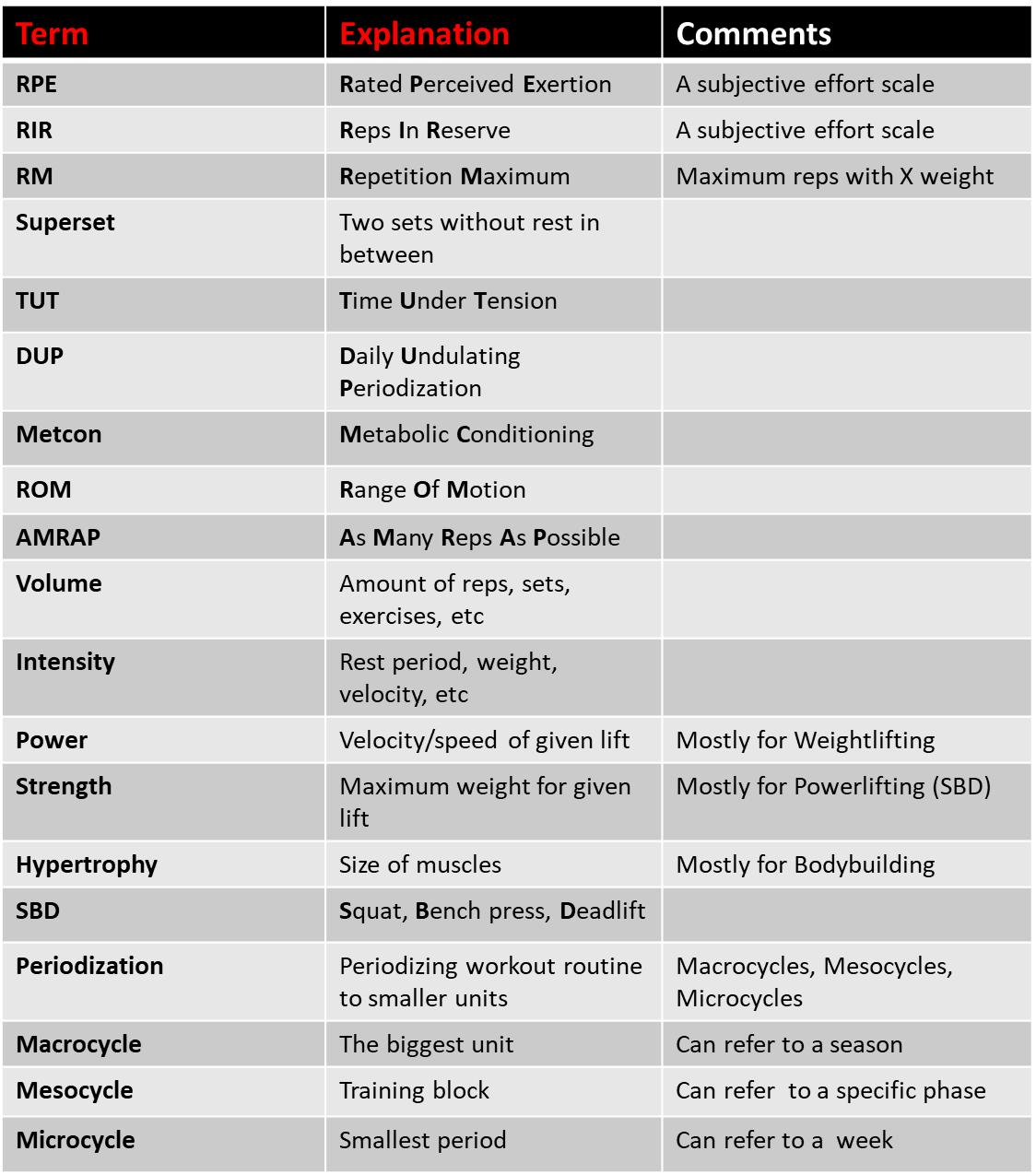
Terms

A list of important basic terms that are used in the fitness world. The next list contains some common terms and their meanings. The terms I published here appear in many programs and training session, and are probably the most famous and used today.


*The explanations and comments I added are highly general and do not cover the idea of each term, but only their overall general idea.

1RM Calculator

I shared here a 1RM calculator, which I find as a great tool to figure out a trainee’s 1RM without attempting an actual risky 1 rep with maximum weight. The 1RM calculator can predict with good accuracy the 1RM from a given amount of weight which was lifted for a given number of reps. The output of a 1RM can assist a trainee with understanding the working weights in lower percentages.


*It’s important to understand that the 1RM calculator isn’t 100% accurate and that it works better in the lower reps range than in the higher reps range.

e1RM and working weights calculator

RM Chart

RM chart- A handy tool that can be used and combined in almost any situation when training in resistance training. On the left, you can see the repetition number, and on the right the percentages of 1RM. Each repetition number has a percentage of 1RM that fits it. So I.E- If someone does 5 Reps “all out”, the weight should be 87% of his 1RM.


*It’s important to understand that this chart shows the percentage at the highest end (maximum weight) a trainee can lift in a given rep range, it doesn’t leave any spare weight/reps and it’s mostly not a smart idea to work on the edge.

e1RM calculator + Working weights calculator

This calculator allows you to calculate the working weights that fit your daily ability and the desired volume and effort level. This calculator is a great tool as it can help you find the right intensity for each given rep range and effort level described (RPE)/RIR), for each exercise. You should insert the weight you lifted, in which RIR (Reps in reserve), and for how many reps. This will calculate your daily e1RM (estimated 1RM) for today. After you know your e1RM, you can insert the described RIR and Reps for the exercise desired, and the calculator will find you the weight which fits all those parameters.


*It’s important to understand that the e1RM calculator isn’t 100% accurate and that it works better in the lower reps range than in the higher reps range. The working weights suggested are only a suggestion and each trainee should find the right intensity for her/himself.

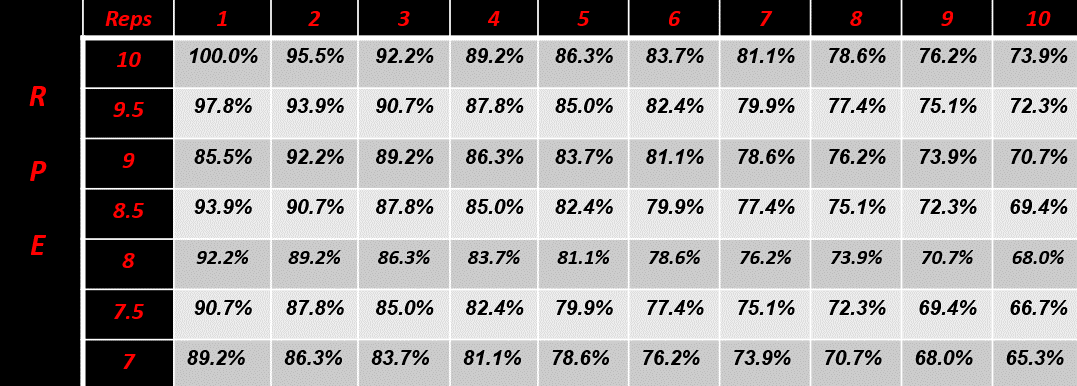
RPE Chart

The RPE (Rated Perceived Exertion) is the subjective effort scale that translates the effort lever that is perceived by the trainee while doing the activity. The chart started in Sweeden when endurance athletes were asked to monitor their rated perceived exertion while running, on a scale of 60-200 (it’s been found to have a strong correlation between that scale the real BPM of the heart). Later, coach Mike Tuchscherer made an amazing translation of that scale to the resistance training world. The RPE chart can help a trainee find the number of reps or the working weight according to his subjective effort feeling.


*It’s important to understand that it may take time and experience to understand how to work with this scale.

en_USEnglish